|
|
Laser
F/X On-line Newsletter - Digest

Second
quarter 2002
Items removed from the Newsletter
section of the Backstage Area originally posted during the
second quarter [April, May, June] 2002.
NOTE: Links on destination
sites are often changed. We provide the digest pages for
archival purposes and the links to external sites were working
when the material was originally published but may no longer
be working.
What's New
New products and services of interest to laserists. Submit your new product information and images in
.gif or .jpg format to our E-mail or contact us.
Mercury
Messenger - SMS System
May 7, 2002: Pangolin Laser Systems and
Eye-Magination announced a new application which
enables you to open new markets. With Mercury Messenger you are able to display SMS messages (simultaneously) on
different types of display i.e. laser and video.
Demonstrations have shown that people are enthusiastic about using SMS this
way and find it a ‘cool’ way to communicate. They use it to display jokes
and to get in contact with each other. Receiving 300 or more messages per
evening is not unusual.
Visitors can use their GSM mobile phone to send SMS messages to a GSM modem
which is connected to your PC running Pangolin software. After receiving a message, Mercury Messenger scans it for rude and abusive
language (automatic or manually) before displaying it.
Club owners can use Mercury Messenger for marketing purposes by using the
collected GSM numbers to send messages thanking their visitors for visiting the club and to
inform them of future events. Using text messaging, they can approach their
specific target group purposefully and at the right time.
Mercury Messenger enables you to:
-
Use your laser system in an innovative way and open new markets
-
Display SMS by using laser or video
-
Customize the laser and video display to your or your clients needs.
Info: www.MercuryMessenger.nl
or www.Pangolin.com
Certified Laser Safety Officer™
program
May 01, 2002: The Laser Institute of America and the Board of Laser Safety™ announces the Certified Laser Safety Officer™ program. The first exams will be held in 2 locations on Sunday, October 13th. The locations are Scottsdale, AZ and Orlando, FL.
Info: www.certified-lso.org
or call 800-345-2737.
UK
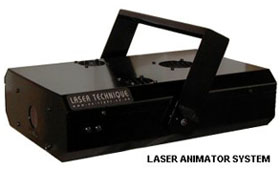
Laser Company Offers A Variety of Gear
April 30, 2002, Cheshire, England: Nu Light Systems Ltd
is now marketing budget laser lighting, world wide, and has built up
an excellent overseas and UK clientele. In 1997, our own range of laser products under the
name of LASER TECHNIQUE was designed and launched.
The MINI SCAN laser is a simple stand alone low power laser which
produces spirographic laser patterns. It is ideal for use in very
low ambient light levels or for a simple eye catching display.
The PROSCAN+ lasers produce spirographic patterns as well, but also
have the added facility of a panning scanner which allows projections
to cover 120 degrees in the horizontal plane, coupled with higher
powers.
The PROSCANs require the PROSCAN CONTROLLER, which has 16 preset
patterns with auto and manual control, variable pattern change, audio
modulation of patterns and panning, beam on/off, auto and manual
positioning of panning. The controller allows up to 16 systems to be
linked together.
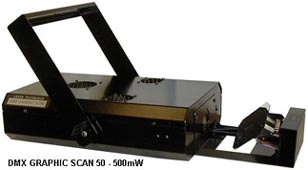
The DMX GRAPHIC SCAN laser is DMX controlled and it just like an
intelligent light fixture. It uses 8 channels and has full pan and
tilt, 32 graphics including 6 banks of simple scrolling text, size
control, modulation effects (X and Y rotations, spinning, shrink and
grow, and 2 3D effects), strobing and scan rate control. It has been designed specifically for the club venue and creates all
the classical laser effects you would expect. It is extremely simple
to use and can be integrated into existing lighting control systems
using DMX without the need of a separate controller.
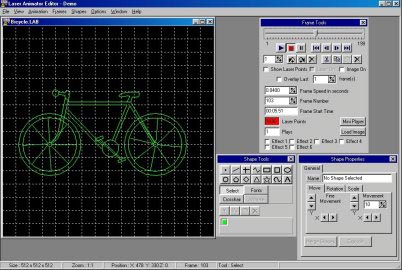
Nu Light's LASER ANIMATOR graphics system is a Windows 95/98 based PC controlled full laser
graphics and animation system. The software is very easy to use and is similar to Shockwave Flash. You can use it to create fantastic
beam effects in smoke, along with full animations and custom logos to suit specific
venues.
There are powerful animation tools, that allow you to create animations very quickly, a large image and animation library is also
provided; even if the user is not fluent in drawing, library images can be used in your own
animations. The system also allows you import any Windows true type text font, including Chinese, Japanese, Hebrew, Arabic text fonts.
The software comes complete with over 20 tutorials which take you through the software functions and the animation processes so that the
user can become familiar with all functions.
Animations that have been created can be imported in to a player, where they can be
organized into a complete show, or have hotkeys assigned so that the press of a keyboard key will play an
animation or sequence that has been programmed - this is very useful for live work.
Alternatively you can automate a show and have it run automatically for set time periods or at specific times.
The interface for the LASER ANIMATOR system also has output lines, that
[via a suitable interface] can be used to trigger other effects, such as
smoke machines, strobes, lighting etc.
Info: http://www.nu-light.co.uk/index.htm
3D
Laser announces new DAC board
April 21, 2002, Spain: 3D Laser
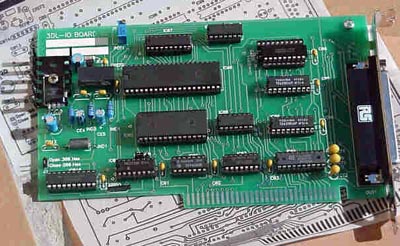
announced the new 3DL I/O V2 DAC BOARD. This is an ISA PC board
that offers:
-
Four 12 Bits DAC for X, Y, Blank Scanners (bipolar out +/- 10 V)
-
Four 8 Bit DAC for PCAOM control with adjustable output level (unipolar out 0 to 5-8
V)
-
32 I/O lines for beam table or other TTL
devices (4 channels can be used for digital color control
of a PCAOM or color-box control)
-
The PCB base address is user selectable (200 / 300 Hex)
This is a non processor based laser graphics
board [it uses the computer's CPU for operation] for lower price,
with all ICs in DIP sockets for easy repair if required. All
of the outputs are fully buffered (DACs & I/O) to avoid
damage to critical/expensive IC's.
The software to drive the board is is 3DLaser Show Pro V 1.20 (available in two months or so), other laser OEM's
have shown an interest in supporting the board with their
software.
This is preliminary info, the board has been tested and is
running, but we can decide soon about the exact pinout / function options.
The output connector is a DB 37 female, due to it's capabilities
exceeding the DB 25 ILDA standard projector connector. Users can easily make a cable adaptor to DB 25 ILDA
standard.
The price for the package with software and hardware is $ 520.00 US$ plus
shipping.
Info: http://www.3dlaser.net/hardware.htm
Pangolin
Buys LAStudio, Retains Uspekh As A Development Resource
March 30, 2002, Orlando: Pangolin Laser Systems
announced today it had concluded a deal for the purchase of all copyrights, distribution rights and source code for LAStudio and TraceIT from the Ukrainian company Uspekh
LTD.
Pangolin has also retained the computer software development services of Uspekh for the continued development of LD2000 software and other Pangolin products.
Uspekh LTD was founded in 1995 and quickly became the Eastern Ukraine leader in the fields of professional audio, lighting equipment, and laser software development. Uspekh currently specializes in systems and services for cinemas, sporting arenas and educational institutions.
LAStudio is a software package [Ed Note: LAStudio debuted
on www.laserfx.com in
1999 - click
here for the original story] that works as an add-on for LD2000. It includes a 3D drawing and object creation program, timeline-based show creation program and an abstract generator. The package allows additional effects and provides some new methods to create scrolling text, abstracts, 3D frames, and other show elements.
TraceIT is a bitmap to vector program that can be used with or without LD2000. When used with LD2000, it allows direct conversion of bitmaps and video sequences to laser, using the QM2000.
Pangolin clients will now have some additional tools to choose from and clients will be able to purchase these tools directly from Pangolin dealers.
Pangolin now has additional development resources that enable
them to create new software more quickly and respond to user’s requests more effectively.
The main LAStudio software package is $1,995 US$ list. The TraceIT bitmap tracer is $595
US$ list. Note that the above prices are only for the software. A QM2000 Intro, Basic or Pro board from Pangolin is required for laser display output.
LAStudio and TraceIT are available now from Pangolin and Pangolin dealers.
Info: www.pangolin.com
World
Scan
News items about
laser show technology, installations and special events/shows from around
the world as well as social items relating to laserists. Our
"Pluses" items cover laser items from the mainstream
media.
Pulses
LaserMedia
circling the drain?
08 May 2002: Reliable sources have
indicated to LaserFX.com that LaserMedia has been sending out
E-mails and faxes offering to liquidate equipment at rock bottom prices
in order to raise some money.
Phone calls to the Los Angeles, California, based company, on
May 1st and 2nd, at different times during business hours, got
only a number of automated menus - and badly corrupted
automated menu recordings at that - to step through with no
humans answering the phones. Messages left on the voice
mail of Harvey Poltnick by LaserFX.com, and E-mails sent to
the address listed on the company web site some days ago were
not returned by press time.
An employee [who asked to remain anonymous] reached by other
means, indicated that "The company is having some
financial troubles" but was not able to make any official
statement or advise if Chapter 11 filing was imminent.
Stay tuned and we will bring you an update as soon as anyone returns
our messages or E-mails.
UPDATE 09 May 2002: This morning we received
an E-mail from a former LaserMedia employee who asked to
remain anonymous as follows:
LaserMedia is going down - fast. All employees are gone and the doors will be
closed next week. Equipment, furniture, etc., is being removed
and put into storage now. Be careful about purchasing any gear as there are liens on
it!
Chapter 11 is coming. Who is next?
You did NOT hear any of this from me!!!
Former LM employee
A call to the company at 14:00 EDT [11:00 PDT]
today reached only the automated menus [which had been
repaired since our last calls]. We left another Voice
message for Harvey Plotnick, requesting an official comment
but it had not been returned by press time.
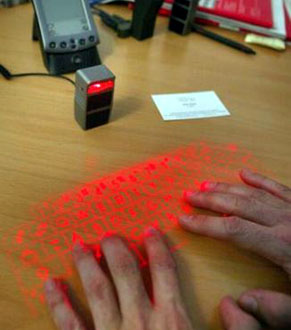
Laser
Virtual Keyboard
A full-size, fully functional, laser virtual keyboard that can be projected onto any surface was shown by Siemens Procurement Logistics Services at the CeBIT fair in Hanover, northern Germany, on Monday, March 18, 2002.
The virtual keyboard interface by developer VKB Inc., Jerusalem in Israel can be integrated in mobile phones, laptops, tablet PCs, or clean, sterile medical environments.
The mini laser projector detects the users interaction with the surface and converts it to keyboard codes. The device can also function as a mouse and mouse-pad eliminating the need for these bulky components in mobile or other small footprint applications. |
 |
Battle
of the SMS Laser Software
Germany, March 18, 2002: MediaLas
today announced the availability their latest software tool,
the SMS-to-Laser interface. SMS2Laser allows one to connect any Nokia mobile phone, by using a serial
cable, to the laser computer. Any SMS sent to this phone is displayed in
real-time in laser output on the laser projector.
Filtering software is included to remove objectionable content
or block SMS messages from selected phone numbers.
Not to be outdone, Pangolin announced on March 19 that "Pangolin will be premiering an SMS application that works with LD2000 for
the first time at the SIB Trade Show in Rimini Italy. Here we will be
showing how SMS can be used with our LD2000 system to do not only SMS text
to laser, but also SMS text to video. The SMS application supports video
animation as well as text display, and can be used with video or laser or
both. There are lots of display options and there is also a database which
logs each SMS message and caller. The database can be used later to send
messages to those who originally sent messages. This way, the system is
two-way in nature."
For those in North America where cellular technology actually
lags behind the rest of the world, SMS stands for "Short
Message Service" which allows owners of GSM cell phones
[the almost universal standard for cellular technology outside
of NAFTA] to send short text messages to each other.
Many North American carriers have web pages that allow you to
send a short text message to another cellular customer, this
is not true SMS just text messaging. SMS is implemented from
the users cell phone and can be sent to a subscriber on another
carrier in GSM service areas. You key the phone number
and the short message into your cell phone and press send.
One might wonder why all the fuss about SMS and lasers?
SMS was introduced almost as an afterthought in the GSM system
but has proven to be one of the most popular
applications. Rather then spending the airtime to call
someone with the simple message "pick up milk & bread
on the way home", SMS allows that text to be delivered
almost instantly and at a very low cost - from any cell phone
to any other SMS enabled cell phone. Carriers report
that SMS messages now comprise a significant percentage of their
traffic and revenues.
Giving a laser system the ability to display SMS messages has
some useful applications. By attaching a SMS enabled
phone to a nightclub laser system or to a laser billboard,
people can send messages which can be displayed as laser text
for all to see. The filtering feature in the MediaLas
version means that objectionable content can be suppressed.
Pangolin will have more information available on their version
after the SIB trade show in Rimini.
Info: www.medialas.com
Info: www.pangolin.com
DISCLAIMER:
Some of the information in the Backstage area is provided by the
persons or companies named on the relevant page(s). Laser F/X does
NOT endorse or recommend any products/services and is NOT
responsible for the technical accuracy of the information
provided. We provide this information as a service to
laserists using the Backstage area.
[ Introduction
| World Scan | What's New
| Special Reports
| Virtual Visits | General Articles
| Digest ]
|