|
|
Laser
Science Projects
Other Applications of Lasers
When lasers were first
invented in the 60's they were described as "a
solution looking for a problem". These days lasers
are useful tools in our everyday life. While laser light
show applications are the most visible and the most fun,
here are just a few of the many other useful (non laser show) applications
of lasers:
 |
- Probably the most
common application of lasers is their
use in CD and DVD players. A
tiny spot of laser light from a
diode laser is focused onto the
spinning plastic disk which has a
metalized coating. The coating
has a series of "lands"
and "pits" in it which
represents the digital data stored
on the disk. The strength of
the reflections of the laser by the
disk surface, is read by a photo detector
and conversed into a stream of
"1" and "0"
signals, fed to the computer or decoder
chip, which then converts it back
into the original data.
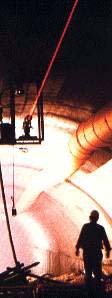
- Construction
applications where pipes or rails must be
laid on a very straight line use the beam
of a low power laser as a guide. In
digging underground, the centre of a
tunnel can be kept accurately aligned
with a laser beam (see photo - left). Home
construction also uses a laser device with a spinning
mirror that can project a line around a room allowing for
accurate placement of windows, doors or even electrical
outlets.
- Lasers are used to
align drills and rivet machines, a laser
dot shows the operator where the hole or
rivet will be placed. Similarly, a line of
laser light projected onto the material can show
a saw operator where the cut will occur
in the material.
- Holography is the
production of a 3D photograph using a
laser as the source of illumination.
Holographic images can be artistic as
well as practical allowing the study of
fragile objects which can not withstand
repeated handling. Holograms can also be
used for vibration and stress analysis
allowing the detection of hidden defects
in materials such as aircraft parts long
before they become a problem. Commercial
aircraft tires and high performance
automotive tires are tested this way. Beacuse
holograms are difficult and
expensive to reproduce, they are
used on credit cards and certain
product pckages as a verification
that the item is an original.
- You are probably familiar with
the bar code scanner in your local supermarket or
store. These units scan a pattern of red light
from a low power HeNe or diode
onto a window or out of a small hand held unit. The reflections from the UPC
(Universal Product Code) on the products placed
or dragged across the window are detected. The
reflections are converted into computer code and
fed to the cash register. This looks up the
product, charges you the correct price, prints
the sales slip and also keeps track of the
inventory so that the store will know when to
re-order popular items.
- In manufacturing,
scanned laser beams can be used for
non-contact defect detection where more
or less light is reflected from moving
material if a defect is present. Lasers can also
be used to rapidly check the size or parts in automated
manufacturing to insure they are within tolerances.
|
Lasers allow for light wave
communications. In the simplest set-up, a laser is
modulated by a microphone and electronics, then projected toward a
photo-detector connected to an amplifier. This allows for
communications in a more secure manner as an interceptor
would have to interrupt the laser beam to tap into the
communications. The down side is that such communications have to
be line-of-sight and weather conditions can block or attenuate the laser
beam making communications unreliable.
On TV and in the movies, you
often see laser eavesdropping
devices. This is because the red
or green beam looks good in the
picture. In reality, an invisible
infrared laser beam is used to that the
person being spied on will not be tipped
off by seeing the laser coming through
the window. These devices work by
detecting variations in the reflections
of the laser beam form the window glass
caused by vibrations. A person
speaking inside a room will cause minute
vibrations in the glass which can be
detected and reconstructed into audio
data. |
|
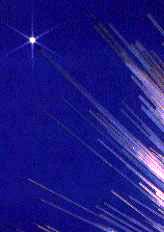
In
most laser based communications systems,
the laser beam is conducted by a glass
fiber optic usually no thicker than a
human hair (see photo - right). As light
operates at much higher frequencies and
speeds than the voice and data
information it carries, many
conversations or data transmissions can
be multiplexed (encoded) onto one fiber
optic. By using different laser
lines (colours) and encoding many
transmissions onto each line, thousands
of transmissions can be carried on a
single hair thin glass fiber as in
modern telephone and data backbone
systems.
Much
of the information you access through
the Internet is transmitted by fiber
optic cables from major node to major
node and even to your ISP. At the
ISP or major nodes, the data can be
recovered form the fiber optic and then
sent along DSL or Cable lines to your
home or school. These transmitters
use high speed modulation of laser
diodes to send the data thought the
fibers. The
data is converted from light to
electronics at the receiving end; the
server is queried, the page you
requested is converted from electronic
impulses to light impulses; sent to your
ISP, which then converts it back to
electronic signals that are forwarded to
your computer (this is a simplified
explanation that omits routing issues).
|
 |
Some
other everyday applications of lasers include frame
straightening on unibody cars; accurate flatness
measurements; CD (Compact Disk) and DVD mastering and
manufacturing; video
disk playback, physics experiments and research with diffraction
and interference; fusion
research; cutting & marking in manufacturing applications;
measuring the diameter of small wires or other
parts; trimming & welding computer chips and
other semi-conductors; high speed and high
quality printing systems; and blood cell
counting.
Medical Laser
Applications
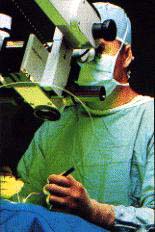 |
This brings us to a special area of laser applications that
benefit many people, medical uses. High power Carbon Dioxide
lasers, which emit powerful beams of infrared (heat)
energy, can be conducted through fiber optics for use as
'bloodless scalpels`. As the laser cuts, it cauterizes (seals) the small blood vessels in the flesh preventing blood loss,
allowing the doctor a clearer view of the incision, and
reducing the risk of infection in delicate surgery. This
type of laser can also be used to cauterize warts and lesions
Using lower powers and different colours
(frequencies) of laser light, lasers can vaporise pigments without
affecting the surrounding skin allowing for the reduction
or removal of tattoos or birthmarks. The carbon particles created
by the vaporisation of the pigments are carried away by the
bloodstream. Lasers can also be used to vaporize a very
thing layer of the skin to remove
blemishes or acne scars.
Lasers are used in eye surgery.
An ophthalmologist (eye doctor) can 'weld' a detached
retina into place with a laser beam stabilizing or
improving vision. The doctor first uses a low power laser
as a 'sight' to aim the equipment then fires pulses from
a more powerful laser at the retina. These pulses are
focused by the lens of the eye and cause lesions and scar
tissue on the retina at the back of the eye. As the scar
tissue heals, it tends to shrink pulling the retina back
into place and holding it there. |
Laser PRK (Photorefractive Keratectomy) is a process that uses lasers to
re-shape the contour of the lens in the eye. Formerly
delicate surgery was used to cut a series of fine slits
in the lens causing it to change thickness and hence
focus. This meant that certain visions problems, like
short-sighted, could be cured. Now lasers are used to
ablate [burn away] small areas of the lens to change it's
focus and improve vision for thousands without surgical intervention.
Recent
advances in the development of photo-sensitive
dies which respond only to certain frequencies
(colours) of light have brought new cancer
treatments especially for brain cancer. The brain
is a very delicate area where traditional
surgical approaches can do more damage that they
repair. Doctors can now inject a patient with a
special die that binds only to cancerous brain
cells, and which absorbs only certain frequencies
(colours) of laser light. By drilling a small
hole in the scull and inserting a thin fiber optic probe, the cancerous cells (which have
absorbed the die) can be destroyed by high power
laser pulses with minimal damage to other nearby
brain structures.
New applications for
lasers and laser based technology are appearing all the
time. If you are interested in keeping up with this
growing field, subscribe to, or visit the web site of, one of the trade journals
such as Photonics Spectra or Laser Focus World.
[ Introduction
| Bibliography | Glossary of
Terminology | Laser
safety overview | Other
applications of lasers | Selected
laser
related web sites | Basic laser
science projects | Intermediate
laser science projects | Advanced
laser science projects | Illustrations
for laser science projects ]
|